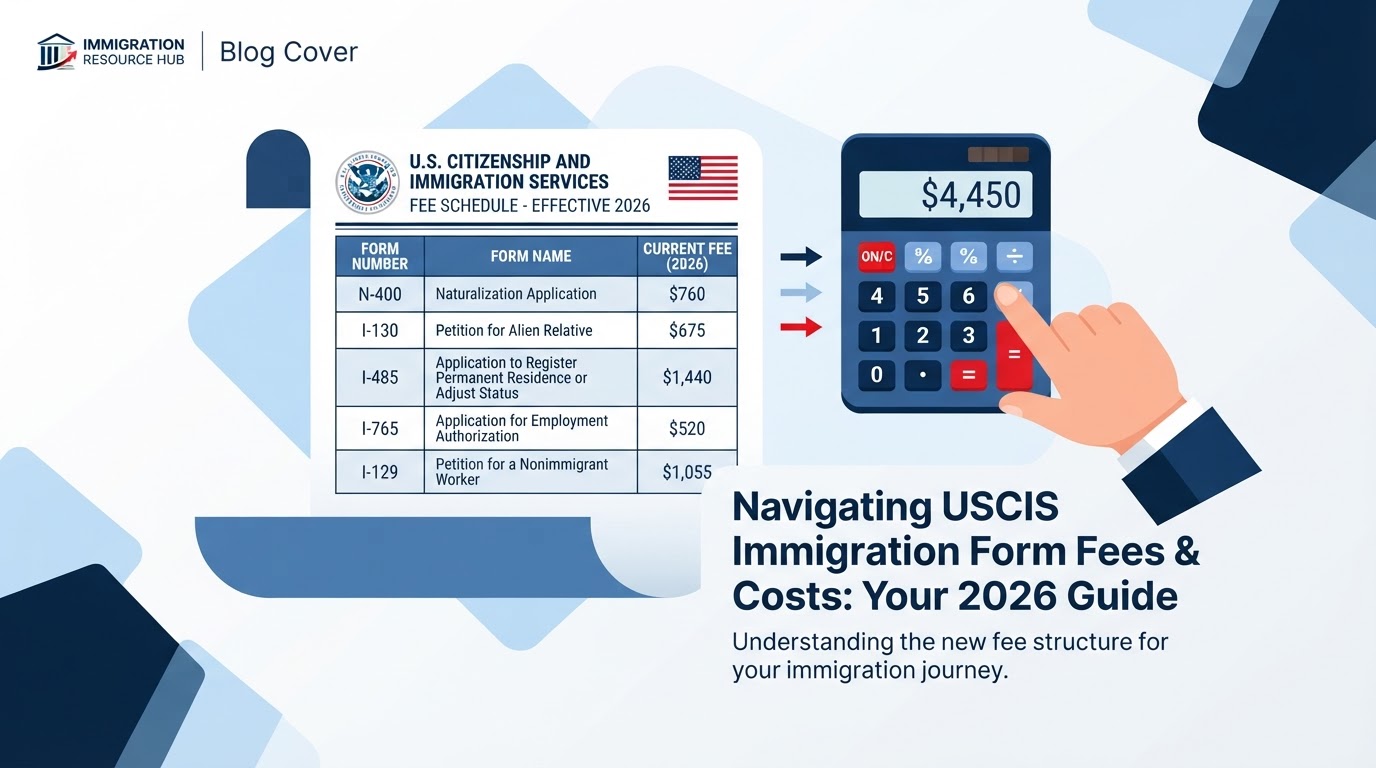
USCIS filing fees are one of the biggest sources of confusion for immigrants and preparers alike. Filing the wrong fee amount is one of the most common reasons applications get rejected and returned, costing applicants weeks of delay. In this complete 2026 cost guide, I'll break down the current filing fees for every major immigration form, explain fee waivers, and show you how to avoid the payment mistakes that derail cases.
Current USCIS Filing Fees by Form
USCIS fees are set by federal regulation and can change, so always verify the current fee on USCIS.gov before filing. The following are the most commonly filed forms and their current fees:
- ✓N-400 Application for Naturalization: $725 (includes $85 biometrics).
- ✓I-130 Petition for Alien Relative: $535.
- ✓I-485 Adjustment of Status: $1,225 (includes $85 biometrics; also covers I-765 and I-131 if filed concurrently).
- ✓I-765 Application for Employment Authorization: $410 (no fee if filed with a pending I-485).
- ✓I-90 Green Card Renewal: $540 ($455 plus $85 biometrics).
- ✓I-751 Removal of Conditions: $595 plus $85 biometrics.
- ✓I-821D DACA Renewal: $495 plus $410 for the I-765 work permit.
- ✓N-600 Certificate of Citizenship: $1,170.
Biometrics Fees Explained
Many forms include an $85 biometrics fee for fingerprinting, photographing, and signature collection. Some forms bundle the biometrics fee into the total filing fee, while others list it separately. When a form requires biometrics, you must pay both the filing fee and the biometrics fee together. Forgetting the biometrics fee is a common reason applications are rejected.
Fee Waivers: Who Qualifies
USCIS offers fee waivers for applicants who cannot afford the filing fees. You can request a fee waiver using Form I-912, Request for Fee Waiver. Fee waivers are generally granted if you receive a means-tested public benefit, if your household income is at or below 150% of the federal poverty guidelines, or if you demonstrate financial hardship. Not every form is eligible for a fee waiver, so check the USCIS fee waiver page before applying.
- ✓Form I-912 is used to request a fee waiver.
- ✓Means-tested benefits include Medicaid, SNAP, SSI, and TANF.
- ✓You must provide proof of income or benefits with your waiver request.
- ✓Naturalization applicants may also use the reduced fee option if they qualify.
How to Pay USCIS Fees
You can pay by check, money order, or credit card using Form G-1450. If you file online through a USCIS account, you can pay by debit card, credit card, or bank transfer. Make checks payable to 'U.S. Department of Homeland Security,' not 'USCIS.' Write your receipt number or full name on the memo line if you have one. Never send cash.
"The right fee paid the right way is the first step to a case that moves forward without delay."
Common Payment Mistakes to Avoid
- ✓Sending the wrong fee amount, especially forgetting the biometrics fee.
- ✓Making checks payable to 'USCIS' instead of 'U.S. Department of Homeland Security.'
- ✓Sending cash, which USCIS does not accept.
- ✓Using an outdated fee amount after a USCIS fee change.
- ✓Filing a fee waiver without the required supporting documents.
Get Help With Your Filing Fees
Getting the fee right is one of the simplest but most important parts of filing any immigration form. A trained document preparer can help you calculate the correct fee, determine whether you qualify for a fee waiver, and make sure your payment is accepted the first time. If you want to learn to prepare immigration forms professionally, our immigration form preparer training covers fees, waivers, and every major USCIS form in detail.

Esmeralda Maya — Founder & Lead Instructor at DoPapers.com
Esmeralda Maya is a Colombian-born entrepreneur, educator, and the founder of DoPapers, an online training platform designed to teach bilingual professionals how to complete U.S. immigration forms and start their own document preparation businesses. After immigrating to the United States in 1985, she earned a degree from Florida State University and initially pursued a career in education. In 2005, she pivoted to the legal document services industry, establishing Forms Preparation Service LLC in West Palm Beach, Florida. Over the next two decades, Maya leveraged her firsthand experience navigating the complex immigration system to develop comprehensive educational courses, transitioning her brick-and-mortar consulting expertise into the scalable digital curriculum now offered through DoPapers.
Ready to Start Your Career?
Become a certified immigration form preparer with our complete online training. Learn the forms that change lives and build a business from home.
Explore Courses →Related Articles
I-485 Adjustment of Status: Document Checklist

How to Fill Out Form I-130: Guide for Families